
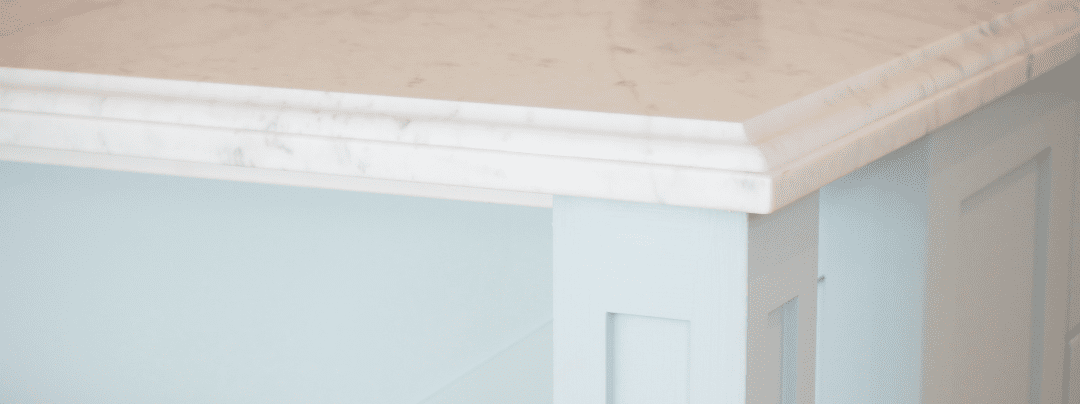
I’ve said it before, and I’ll say it again, you don’t know what you don’t know.
When it comes to a kitchen renovation, there are so many design decisions to make along the way to your new space. And unless this is your second (or third) kitchen, chances are you’ve probably never even thought about benchtop edge profiles.
Most people don’t. You’re busy focusing on the big things, cabinet styles, colours, and benchtop materials, and rightly so. But it’s often these smaller, finer design details that quietly shape the overall look and feel of your kitchen.
That’s exactly what we’re going to break down here: Benchtop edge profiles! This little helpful guide will explore different types of benchtop edge finishes, making sure you don’t overlook this beautiful detail and help you on your benchtop edge decision path. Let’s dive in.
What Are Kitchen Benchtop Edge Profiles?
Kitchen benchtop edge profiles are like choosing the frame around a piece of artwork.
The artwork “the benchtop” stays the same, but the frame changes how you experience it, visually and practically.
A sharp, square frame gives a modern, clean look, but it can feel more rigid in a busy family home.
A rounded frame softens the edges, making it more comfortable and safer for everyday life, especially with kids around.
And a thicker, more detailed frame feels bold and premium, designed to make a statement while adding a sense of durability and presence.
Same artwork underneath, but the frame completely changes the personality, feel, and function of how it’s experienced in the space.
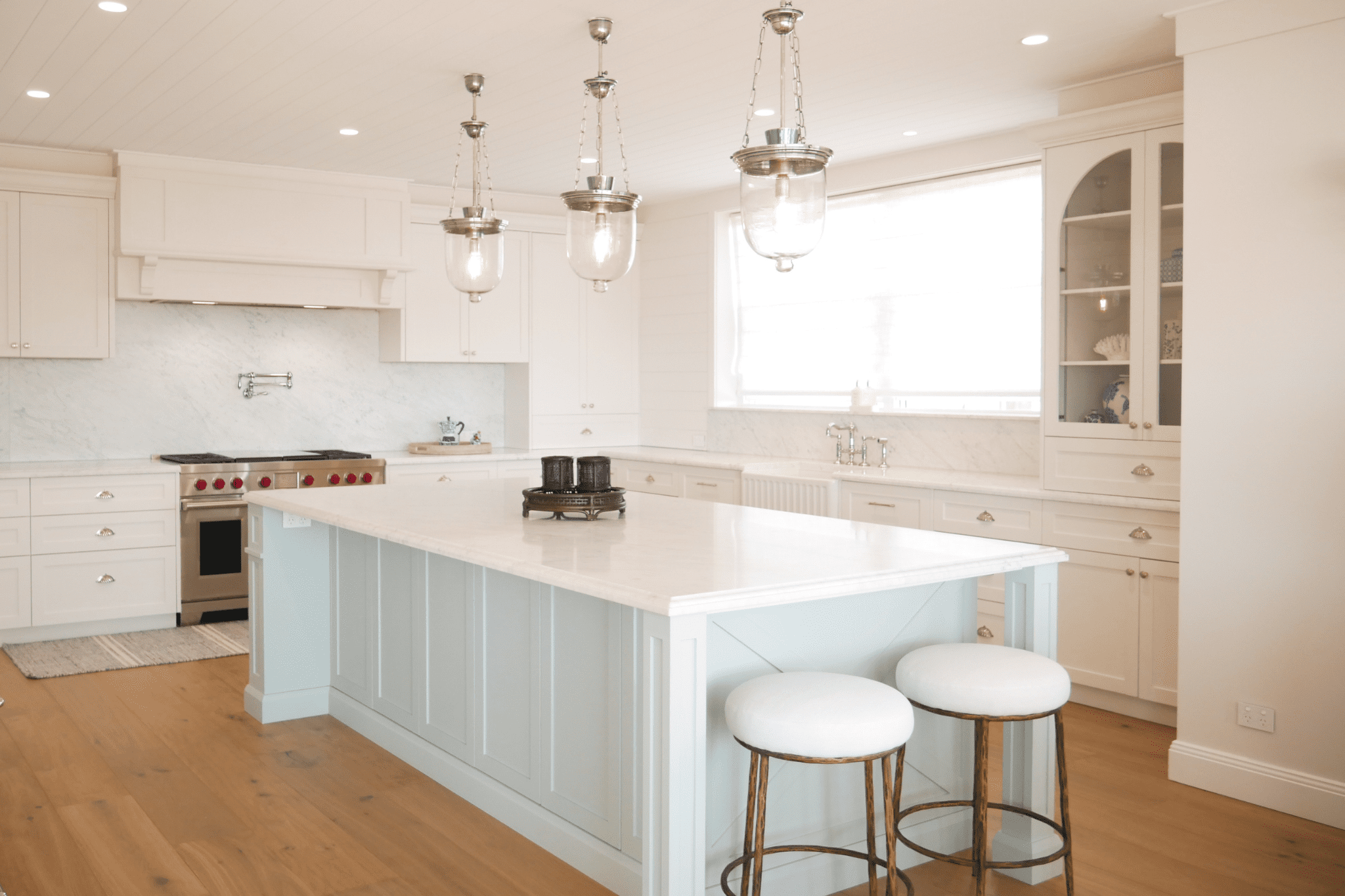
Why Benchtop Edge Profiles Matter in a Kitchen Renovation
Your edge profile selection matters for the following reasons:
1. Visual impact on kitchen style (modern vs traditional)
2. Safety and family-friendly considerations
3. Durability and chip resistance
4. Material compatibility (laminate vs stone vs timber)
5. Influence on overall design: “the benchtop edge finish”
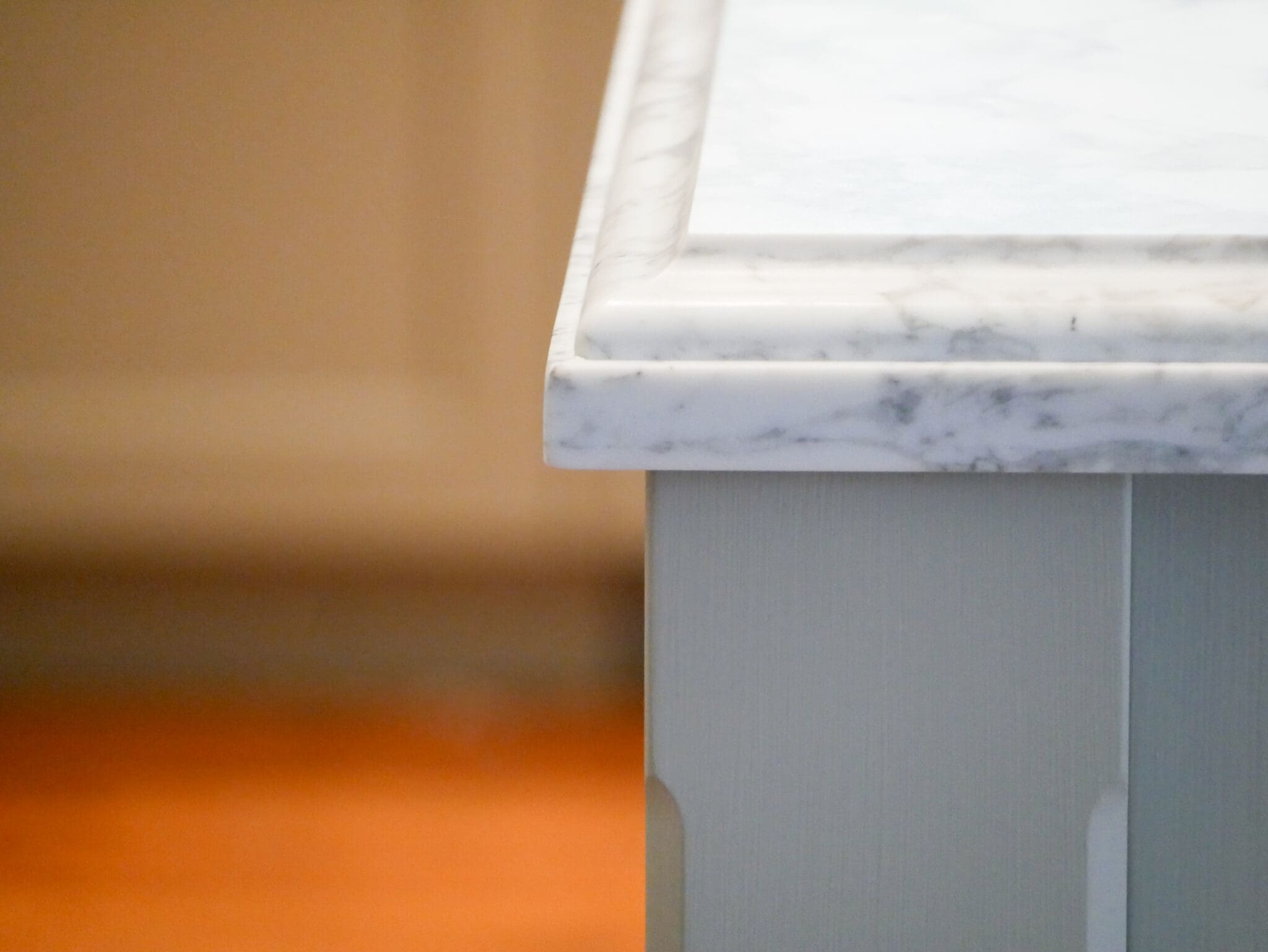
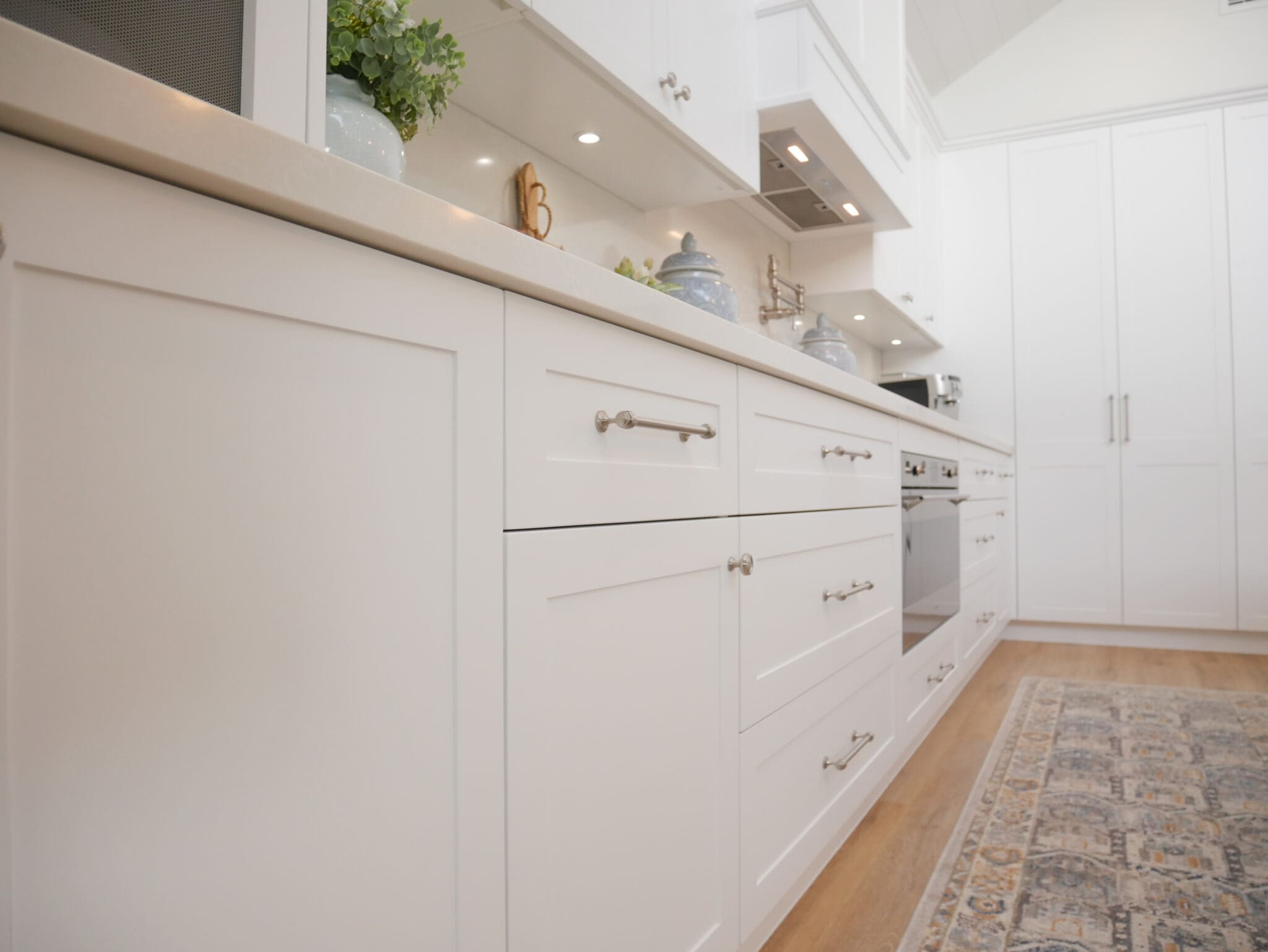
Main Types of Bench Edge Profiles
Square Edge Benchtops (Modern & Minimal)
Square benchtop profiles are all about clean lines and sharp, defined edges that give your kitchen a really modern, streamlined look. Unlike more detailed or rounded profiles, the square edge keeps things simple and minimal, which is why it works so well in modern kitchen designs.
Square benchtop edge profiles are also among the most popular in Australia, mainly because they’re the easiest to manufacture and produce a clean, consistent finish. That practicality, combined with their modern look, makes them a go-to choice for many new kitchens.
Types Of Square Benchtop Profiles
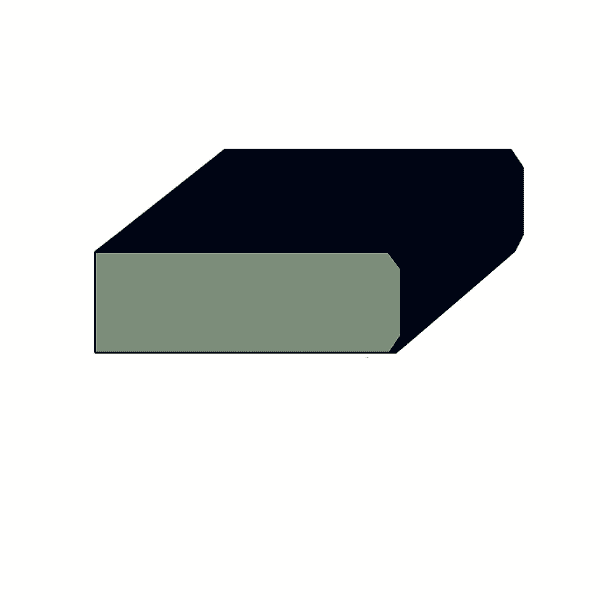
Aris Edge Profile (Softened Square Edge)
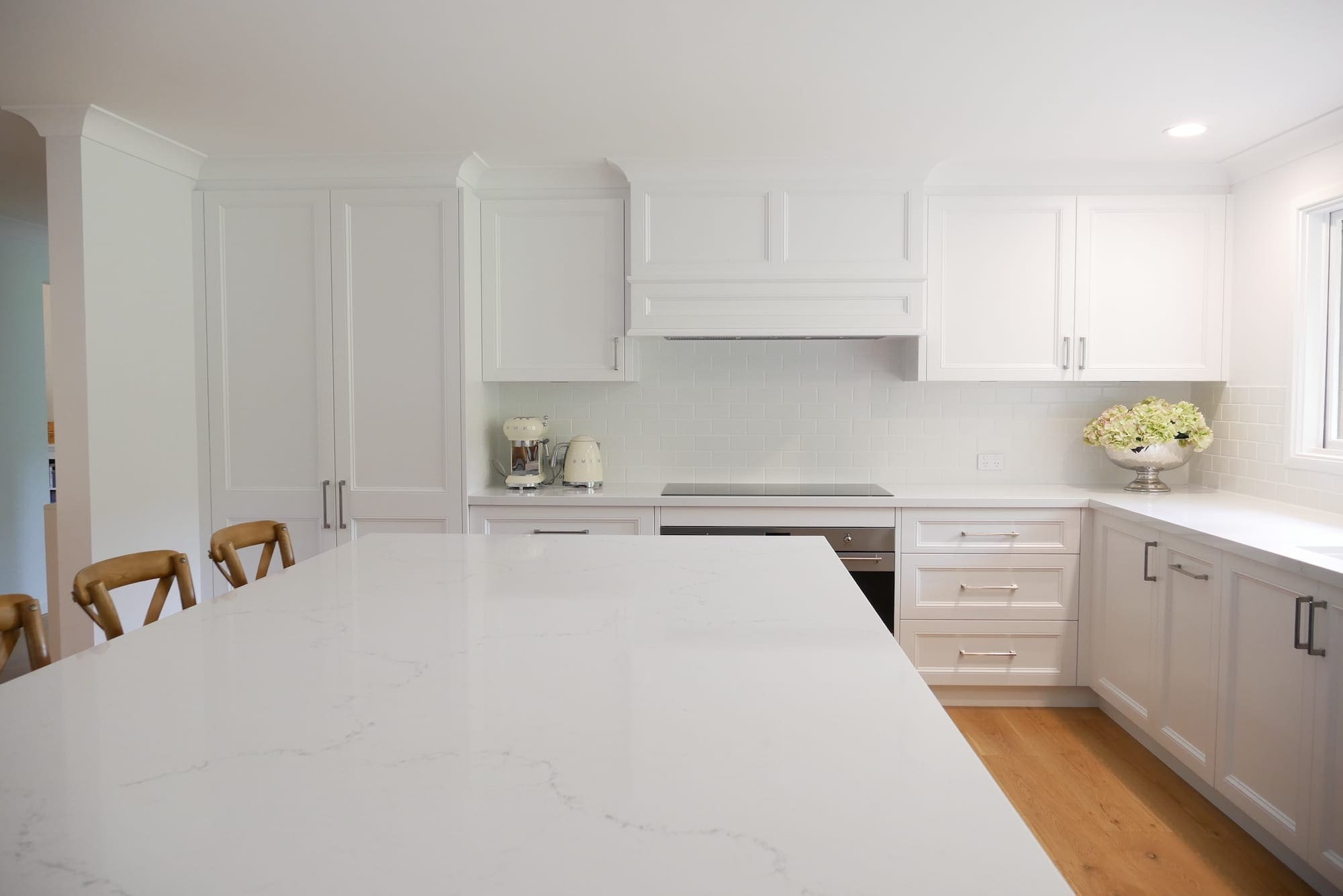
The aris edge profile sits between a sharp square edge and a fully rounded finish. Instead of a hard 90-degree corner, the top edge is slightly bevelled, which softens the look while still keeping a clean, modern style.
It’s a popular choice because it’s practical as well as stylish. That small angled detail helps reduce chipping on the edges, making it a more durable option for everyday use, especially in busy family kitchens.
Laminate: Limited
Timber: Yes
Stone: Yes
Why not laminate: Can be achieved in some post-formed laminates, but the bevel is less precise and may show wear over time.
Durability: ⭐⭐⭐⭐☆
Slightly softened edge helps reduce chipping while maintaining a crisp modern finish.
Family friendly: ⭐⭐⭐⭐☆
Safer than a sharp square edge, with a more forgiving corner.
Price range: $$ (Low–mid range)
Often included as a standard upgrade in stone benchtops with minimal additional fabrication cost.
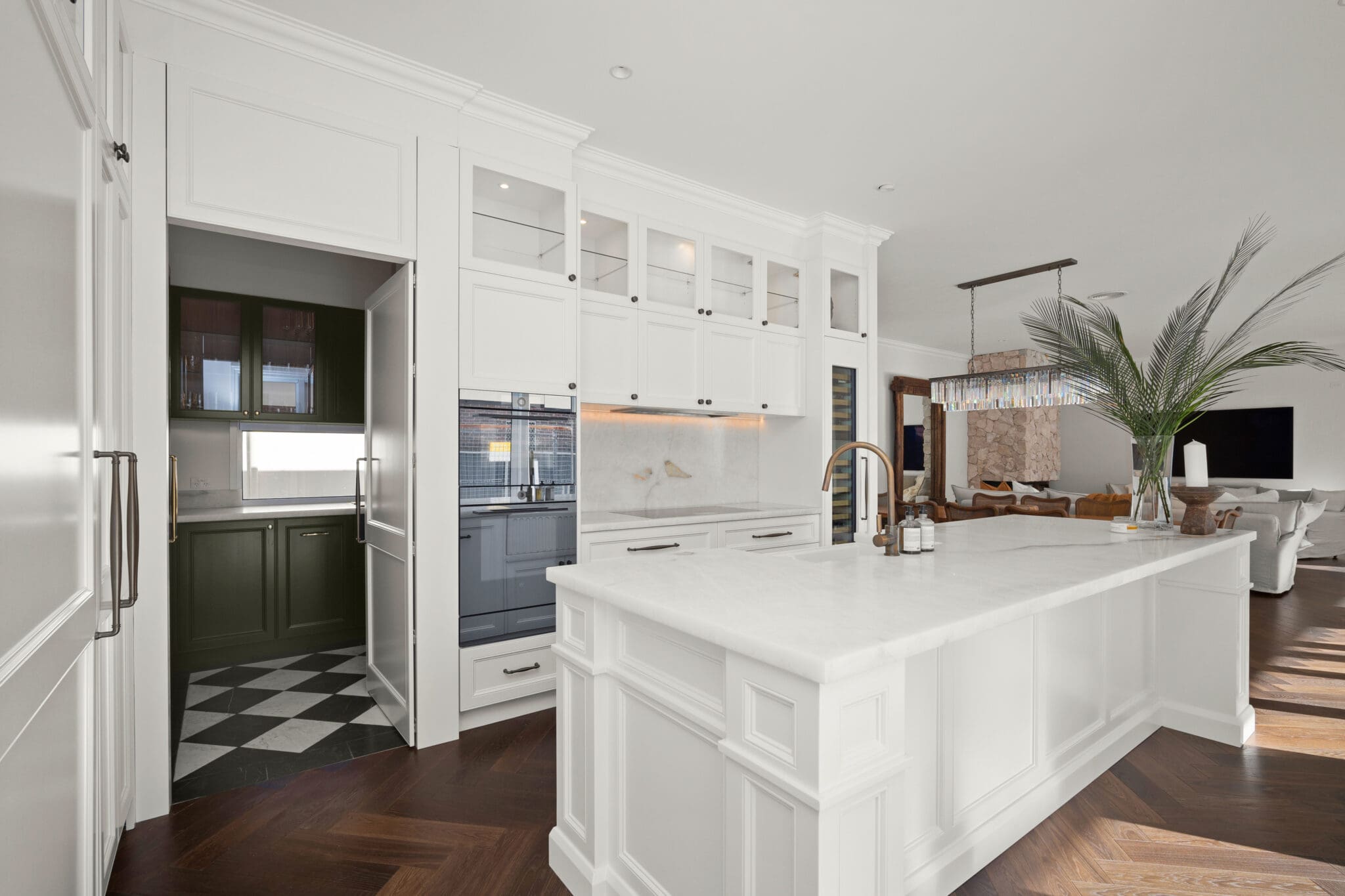
Mitred Edge Benchtops (Thick, Premium Stone Look)
This is where things start to feel more high-end.
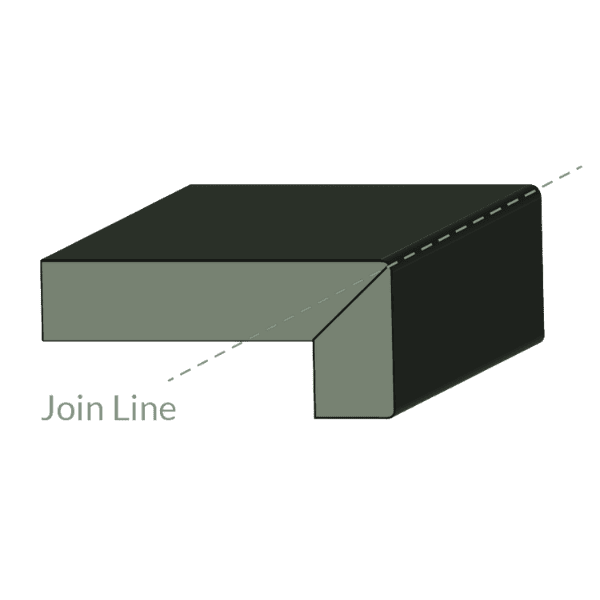
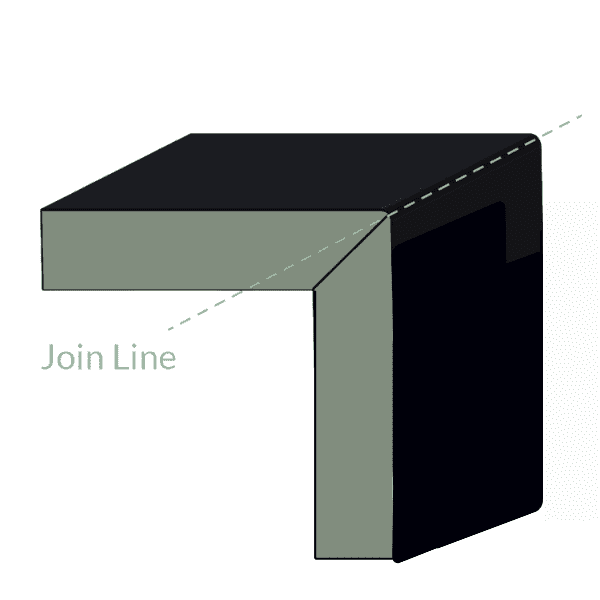
Most stones come in a standard 20mm thickness, but in modern kitchens, especially islands, people often prefer a thicker, more solid-looking benchtop. Instead of using a second slab (which can get expensive), a mitred edge is used to create that same built-up appearance.
The way it works is quite clever. The stone is cut at a 45-degree angle and joined together, so the edge appears as one solid, thick piece with a seamless finish.
It’s a popular choice because it delivers that premium, architectural look without the need for extra material, just precise fabrication. The end result is a clean, substantial benchtop that suits modern kitchen designs perfectly.
Laminate: No
Timber: Limited
Stone: Yes
Why not laminate: The internal core would be exposed at the 45° join, causing visible layering and structural weakness.
Durability: ⭐⭐⭐⭐⭐
Very strong when properly fabricated in stone, with excellent structural integrity.
Family friendly: ⭐⭐⭐☆☆
Not a soft profile, but safe and smooth when finished correctly.
Price range: $$$ (Mid to premium)
Higher cost due to precision cutting, labour, and fabrication requirements.
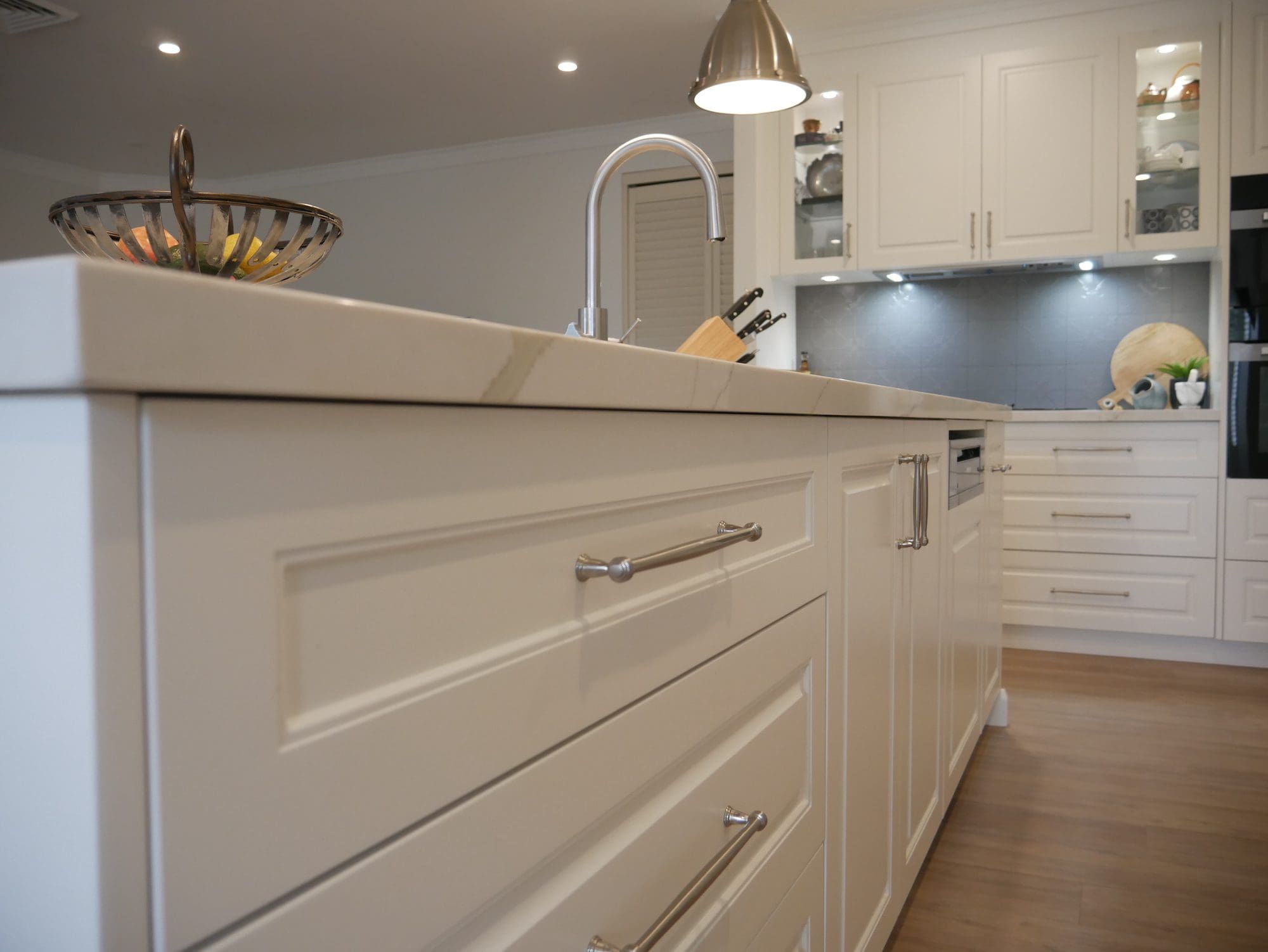
Waterfall Edge Benchtops (Statement Island Feature)
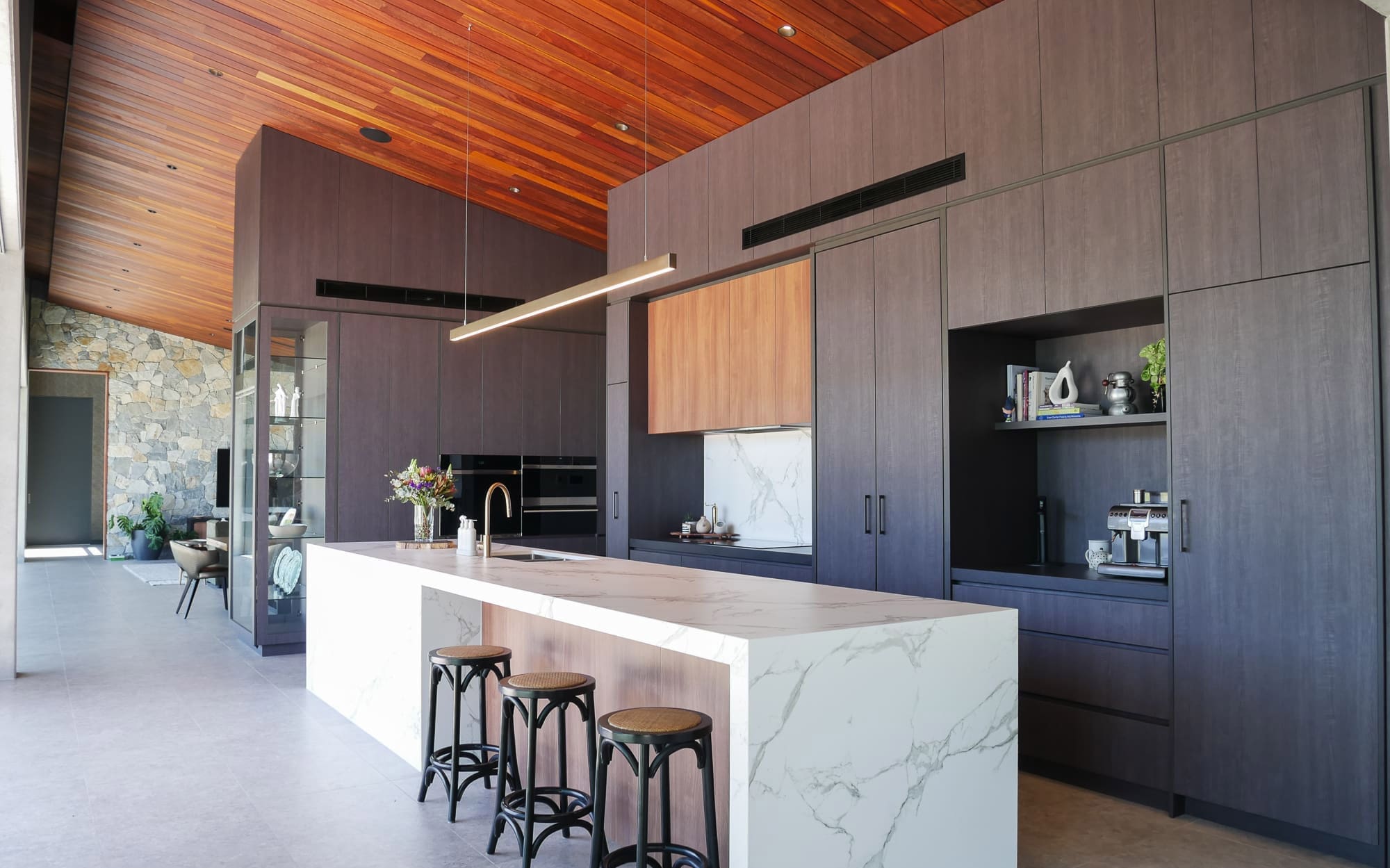
The waterfall benchtop is, I’d have to say, one of the most overrated edge profiles. It definitely looks impressive, there’s no denying it has that “wow” factor. But in reality, you’re paying for extra slabs of stone that really only exist for appearance.
This style takes the same benchtop material and runs it down the sides of the cabinetry, creating that continuous “flowing” effect that drops to the floor like a waterfall.
Realistically, your benchtop has one main job, to handle everyday cooking, hot pots and pans, spills, and general wear and tear. The waterfall edge doesn’t really add anything to that. It’s purely visual.
It’s a bold design choice, and when it’s done well, it can look incredible, but it’s worth being clear that it’s more about aesthetics than function.
Laminate: No
Timber: Rare
Stone: Yes
Why not laminate: You can’t create a seamless vertical wrap without visible joins or damage risk.
Durability: ⭐⭐⭐⭐⭐
Excellent protection for the sides of cabinetry when used in stone.
Family friendly: ⭐⭐⭐⭐☆
No sharp exposed edges on the island sides, but stone corners still need consideration in tighter spaces.
Price range: $$$$ (Premium)
Higher cost due to extra material, fabrication, and installation time.
Shark Nose Edge Profile (Floating Modern Look)
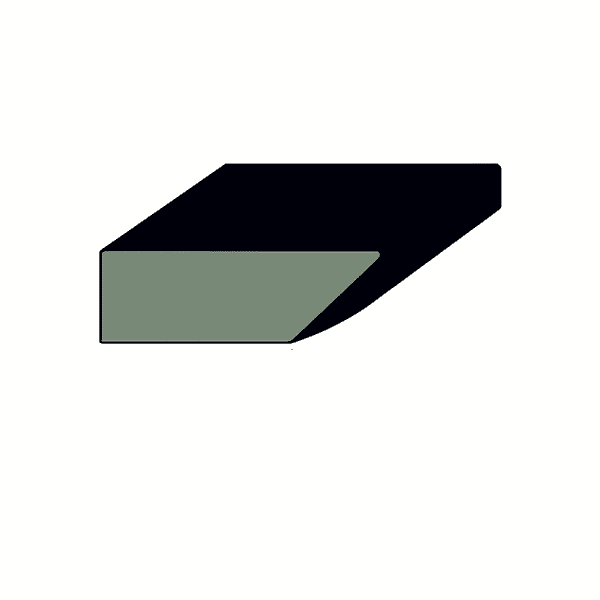
The shark nose benchtop is a very modern, sharp-looking profile where the edge drops away with a strong angled cut underneath, creating that bold “floating” effect.
From above, it keeps things clean and minimal, but underneath, there’s a deep shadow line that makes the benchtop look thinner, lighter, and more refined. It’s a popular choice in contemporary kitchens because it delivers that high-end, architectural feel without adding bulk or unnecessary detail.
Laminate: No
Timber: Yes
Stone: Yes
Why not laminate: Requires precise underside routing and shadow-line detailing that can’t be properly achieved with laminate sheet construction.
Durability: ⭐⭐⭐⭐☆
Strong when fabricated well, but the detailed underside needs careful workmanship to avoid damage.
Family friendly: ⭐⭐⭐☆☆
No sharp top edge, but the underside detail is still rigid and less forgiving.
Price range: $$$ (Mid to premium)
Requires more precision fabrication and skilled finishing.

Rounded Edge Profiles (Soft & Family-Friendly Options)
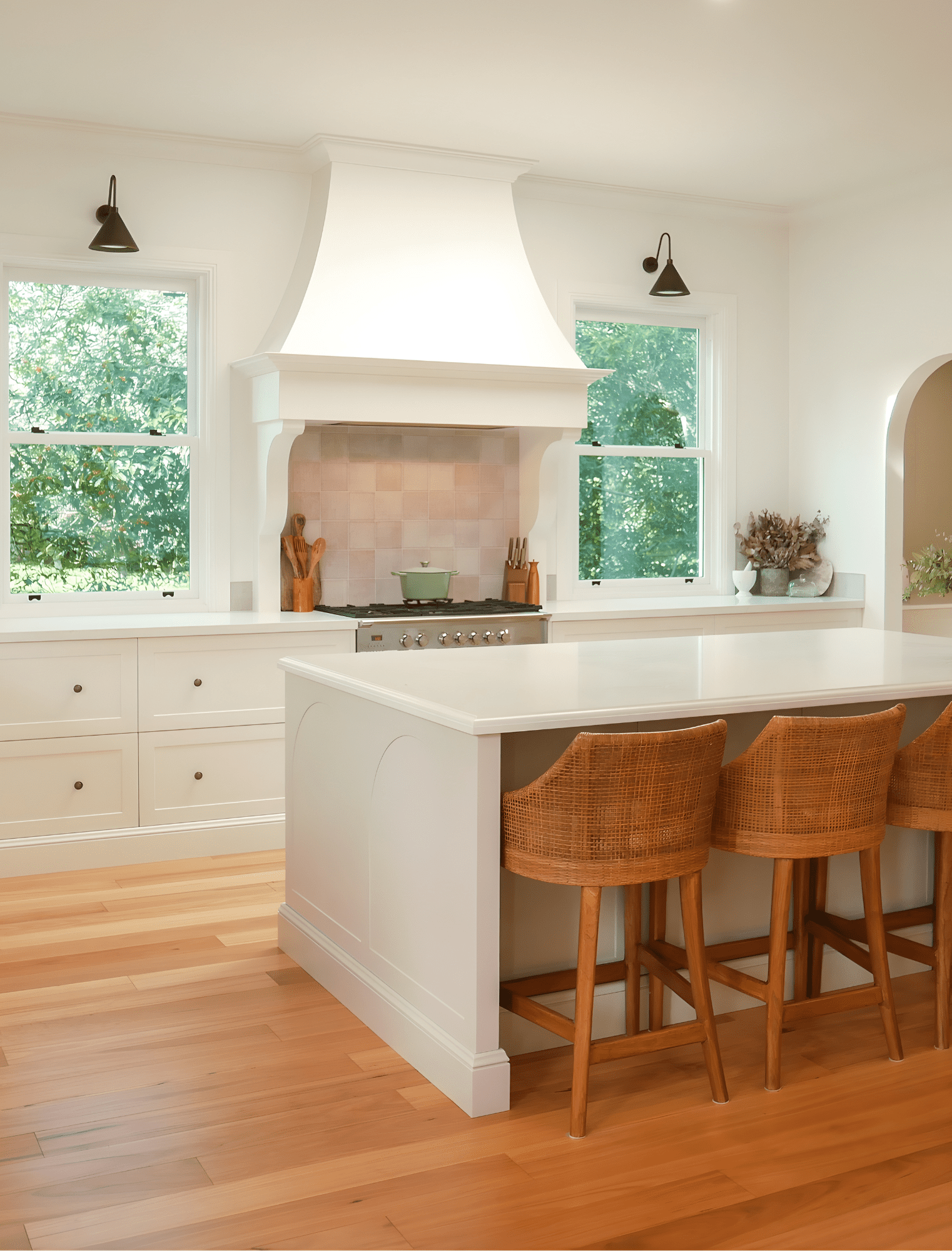
If you imagine running your hand along a benchtop and there are no hard edges or sharp corners, that’s what a rounded edge profile feels like.
Round benchtop edge profiles are a softer, more traditional finish where the edge is curved instead of sharp. They take away those hard corners, which makes them a really practical choice for families with young kids or anyone who just wants a more forgiving, comfortable feel in the kitchen.
While they’re not as modern as square or mitred edges, they still work beautifully in classic or transitional kitchen designs where you want everything to feel a bit softer and more relaxed.
Types Of Round Benchtop Profiles
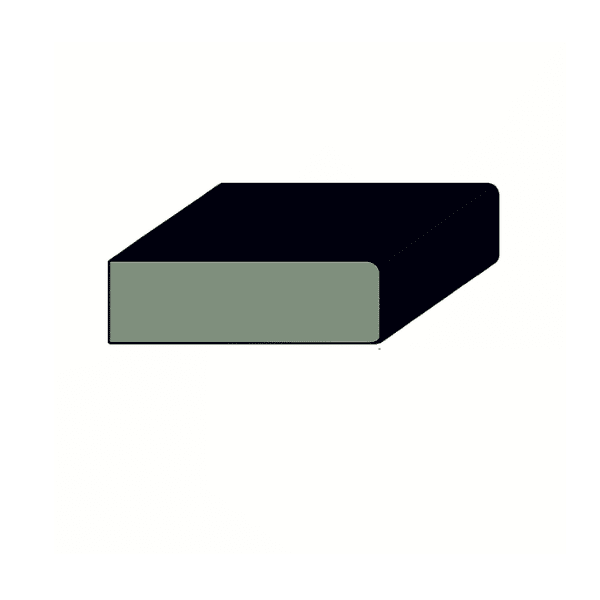
Pencil Round Edge (Most Practical Option)
Also known as a pencil edge, this profile has a small, soft curve along the top, about the size of a pencil, which gives it a clean, simple finish without any sharp corners.
It’s easily one of the most practical choices, especially for families with young children, because there are no hard edges to bump into. It still keeps a neat, linear look, just with a subtle softness that takes the edge off.
Laminate: Yes
Timber: Yes
Stone: Yes
Why laminate works:
Pencil round edges are ideal for laminate because they’re easy to achieve with post-formed edges or matching edging strips, giving a consistent, durable finish without complex fabrication.
Durability: ⭐⭐⭐⭐☆
A strong everyday option that holds up well. The softened edge also helps reduce chipping compared to sharper profiles.
Family friendly: ⭐⭐⭐⭐⭐
One of the safest options thanks to the rounded top edge, making it ideal for busy households and young children.
Price range: $ (Low to standard range)
Usually included as a standard edge in most laminate benchtops and a cost-effective option in stone and timber.Top of Form
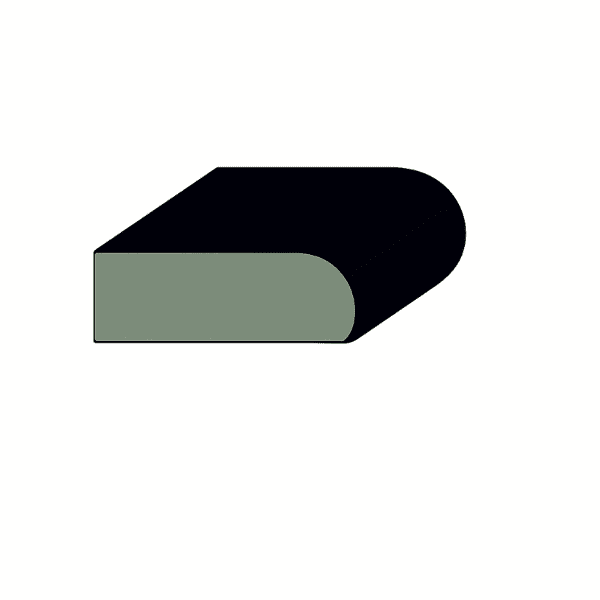
Bullnose Edge (Fully Rounded Finish)
The bullnose profile has a fully rounded edge that creates a smooth, soft finish all the way through. It’s a classic choice that also works really well in family-friendly kitchens because there are no sharp corners to worry about.
It also has a nice visual effect, that continuous curve can make smaller kitchens feel a bit more open and spacious, rather than boxed in by hard lines.
Laminate: Yes
Timber: Yes
Stone: Yes
Why: Rounded profiles are easy to shape and ideal for all material types.
Durability: ⭐⭐⭐⭐⭐ (very high)
Best for reducing chips and wear over time.
Family friendly: ⭐⭐⭐⭐⭐ (excellent)
No sharp corners, safest option for children and high-traffic kitchens.
Price range: $–$$ (Budget to mid-range)
Pencil round usually included; bullnose slightly more.
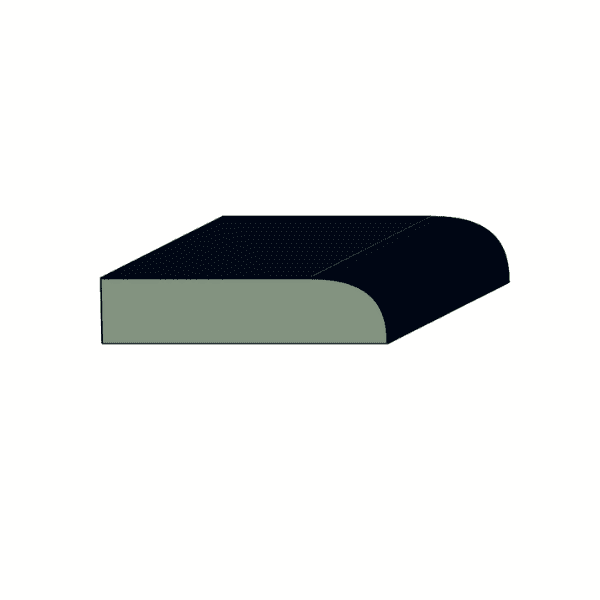
Half Bullnose Edge (Balanced Modern + Soft)
The half bullnose edge is a nice middle ground between a sharp square edge and a full rounded profile. The top of the benchtop is smoothly rounded, while the underside stays flatter, giving you a softer feel without going too traditional.
It’s a great option if you want something a bit more forgiving than a square edge, but still clean and structured enough to suit modern kitchens.
Laminate: Yes
Timber: Yes
Stone: Yes
Why laminate works:
Half bullnose edges are easy to achieve with laminate through post-forming or edging strips, making them a practical and widely available option.
Durability: ⭐⭐⭐⭐☆
Holds up well in everyday use. The rounded top helps reduce chipping and wear compared to sharper edges.
Family friendly: ⭐⭐⭐⭐☆
Safer than square edges thanks to the softened top, while still maintaining a clean look.
Price range: $–$$ (Low to mid range)
Often included or a small upgrade in laminate, and a modest fabrication upgrade in stone and timber.

Double Bullnose Edge (Decorative Traditional Finish)
The double bullnose edge is a fully rounded profile on both the top and bottom, giving the benchtop a smooth, continuous curve all the way through. It has a much softer, more traditional feel compared to modern square edges.
This profile is usually created by building up the edge using two pieces of material, which is what allows that full rounded shape on both sides. The result is a thicker-looking benchtop with a more decorative finish.
Laminate: Limited
Timber: Yes
Stone: Yes
Why not laminate:
Laminate struggles to achieve a true double curve on both top and bottom edges without visible joins, so it’s not commonly used for this profile.
Durability: ⭐⭐⭐⭐☆
Very durable when properly built up, with no sharp edges to chip. The rounded form helps minimise wear over time.
Family friendly: ⭐⭐⭐⭐⭐
One of the safest options — no sharp edges at all, making it ideal for family homes.
Price range: $$–$$$ (Mid range)
Requires extra material and fabrication to build up the edge, which increases cost compared to simpler profiles.
Lamb’s Tongue Edge (Decorative Luxury Detail)
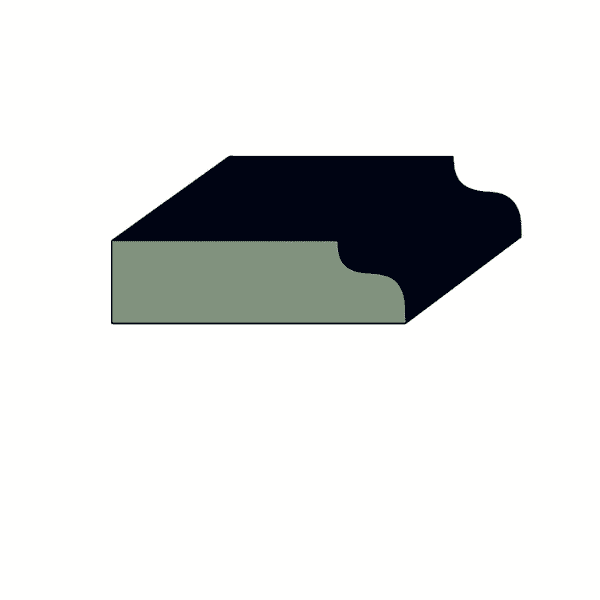
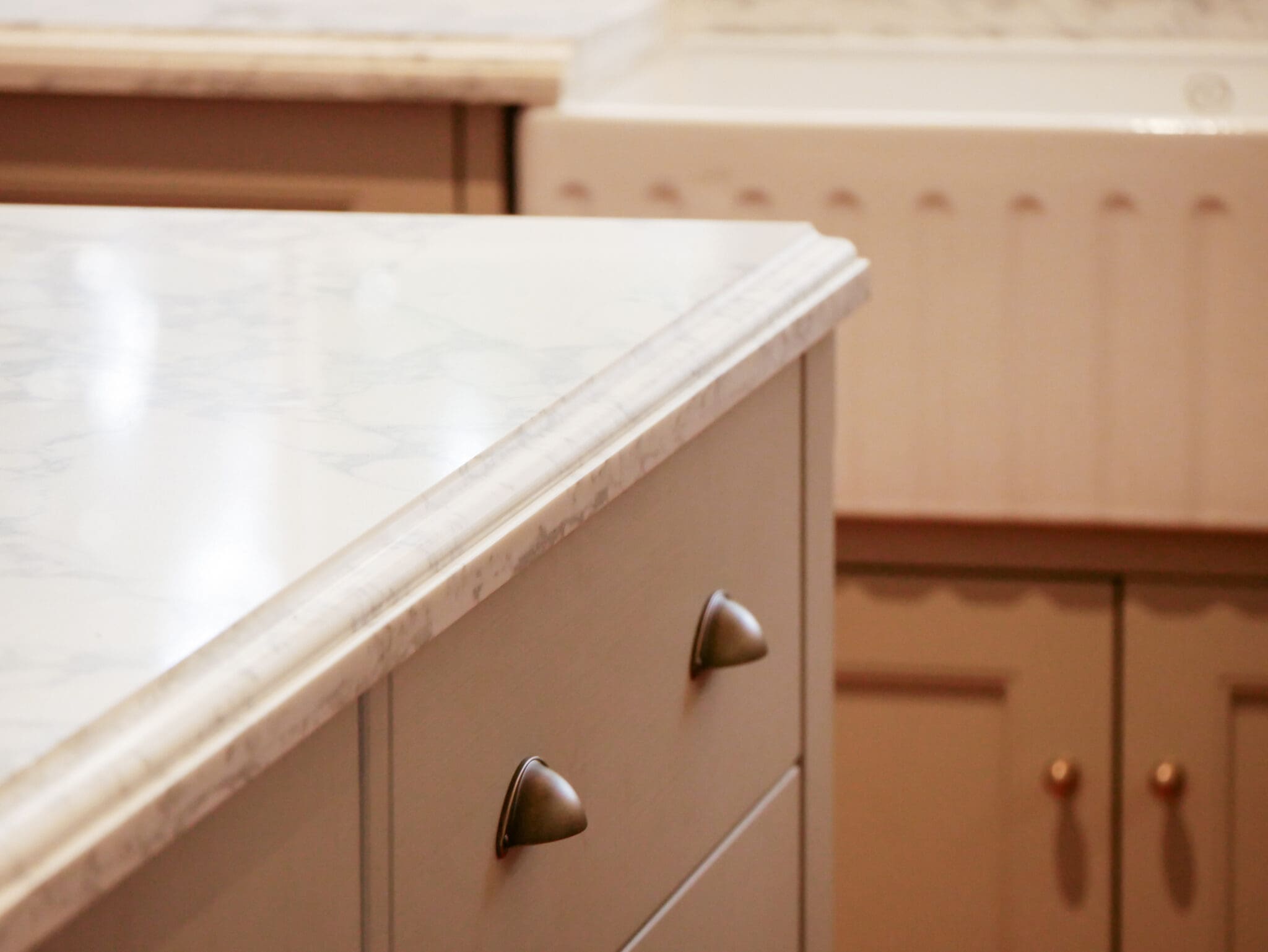
The lamb’s tongue profile is a more decorative edge that features a soft curve flowing into a subtle groove underneath the benchtop. It has a bit more detail than a simple rounded edge, which gives it a more traditional and slightly refined look.
It works well in classic kitchen designs where you want the benchtop to feel a bit more styled, rather than completely minimal. The small curve underneath also adds a sense of depth and craftsmanship, without being too over the top.
Laminate: No
Timber: No
Stone: Limited
Why not laminate: Requires carving and fine routing detail not possible in sheet-based material.
Durability: ⭐⭐⭐☆☆
More decorative than functional; detailing can wear over time.
Family friendly: ⭐⭐⭐☆☆
Soft edges but decorative grooves can trap wear over time.
Price range: $$$ (Mid to premium)
Skilled craftsmanship required.
How Laminate and Stone Change Your Benchtop Edge Options
The material you choose for your benchtop has a big impact on what edge profiles are possible. Laminate benchtop edge profiles are more limited because laminate is built from a core board with a surface layer, so they suit simpler, practical edges like square, pencil round, or bullnose profiles.
Stone, on the other hand, can be cut, shaped, and joined in more detailed ways, which allows for more premium finishes like mitred edges, shark nose profiles, and waterfall ends.
Timber sits somewhere in between, depending on the level of detail and craftsmanship involved. But in all honesty, before you opt for a timber benchtop, take a look at your timber chopping board and consider down the road what your timber benchtop will look like.
How much do different benchtop edge profiles typically cost to fabricate?
The cost of benchtop edge profiles really depends on how simple or detailed the finish is, and the material you’re using, laminate, timber, or stone all sit at different price points.
As a general guide, simple benchtop edges like square, pencil edge, or aris are usually included in the base price, especially in laminate and standard stone benchtops. They’re quick to produce and don’t require much extra fabrication.
Once you start moving into more detailed finishes, the cost goes up. Profiles like bullnose, half bullnose, or shark nose require more shaping and labour, so there’s usually a small added fabrication cost per metre. More complex stone finishes like mitred edges or waterfall ends are the most expensive, because they involve extra slabs, precision cutting, and much more labour to achieve that seamless look.
In simple terms, the more detailed or “built-up” the edge looks, the more time and material it takes to make, and that’s what drives the price up.
Which Benchtop Edge Profile Is Best for Your Kitchen?
There’s no “one-size-fits-all” answer; the best edge profile really comes down to how you use your kitchen, your style, and your budget. It’s these small details that end up making a big difference in the overall look and feel.
| Best for Modern Kitchens | Best for Family Friendly Kitchens | Best for Luxury Kitchens | Best Budget-Friendly Option |
|
Square edge Aris edge Shark nose Mitred edge |
Pencil round Bullnose Half bullnose Double bullnose |
Mitred edge Waterfall edge Shark nose Lamb’s tongue (for a more classic luxury look) |
Square edge Pencil round Half bullnose |
Which companies supply custom benchtop edge profiles with installation services?
In most cases, your kitchen company will coordinate this entire process for you, from selecting the edge profile through to installation on site. For example, when we complete your kitchen renovation at Harrington Kitchens, we can help coordinate all of this for you, making sure your benchtop, cabinetry, and edge profiles all come together as one finished design.
Design your Own Kitchen with Harrington Kitchens
When it comes to the finer details of your kitchen, like your benchtop edge profile, it’s often the small choices that make the biggest difference. That’s where our team comes in. We’re here to guide you through all the options, so you can feel confident in every decision along the way.
Because as you’ll see in our kitchen design gallery, we don’t believe in limiting your choices.
Every kitchen we create is uniquely designed around the people who use it, their style, their lifestyle, and how they want their space to feel.
If you’re planning a kitchen renovation and want to explore different materials, find answers to our most FAQ about kitchen benchtops, including benchtop thickness and more you can view our full range of options on our kitchen benchtops page. It’s a great place to get inspired and start narrowing down what feels right for your home.
And when your fully ready to proceed with your kitchen renovation, then contact us to get the full Harrington Kitchen experience.
Recent Comments